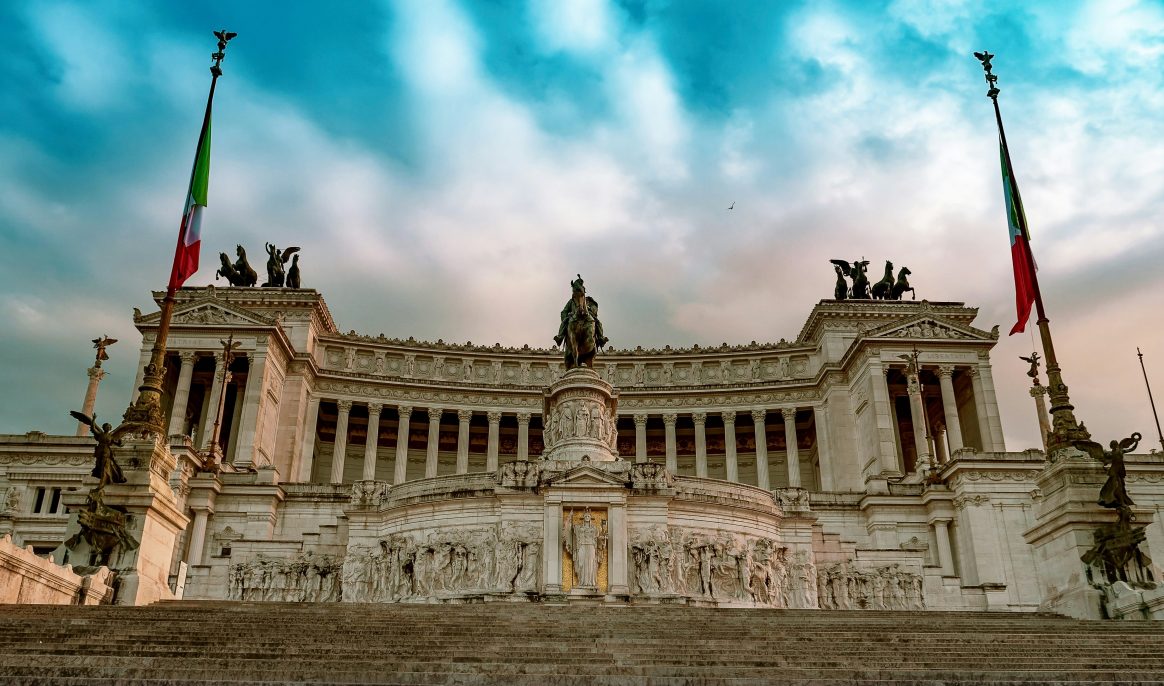
©Mauro Grazzi via Unsplash
-
Jul 08, 2026 09:11
A study by La Sapienza University and ISPRA reveals that the Vittoriano is sinking by one millimeter per year on its northwest flank due to the fragility of the alluvial soils.
The monumental heart of the Italian capital harbors a geological secret that only the most advanced aerospace technology has been able to uncover. The Vittoriano, a majestic symbol of national identity that dominates Piazza Venezia, is shifting imperceptibly but steadily.
The warning comes from an in-depth scientific study conducted by Nhazca, a university-based applied research startup within the Department of Earth Sciences at La Sapienza University of Rome, in close collaboration with the Higher Institute for Environmental Protection and Research (ISPRA). By analyzing orbital data, experts have determined that the marble colossus is undergoing asymmetric and localized subsidence—invisible to the naked eye—that jeopardizes the structure’s integrity.
A-DInSAR technology and twenty years of orbital imaging of the monument
To map these millimeter-scale movements without altering even the smallest part of the historic marble, scientists used the advanced differential radar interferometry technique, known in the field by the acronym A-DInSAR. The research team analyzed more than 300 very-high-resolution radar images acquired between 2002 and 2019 by the European Envisat satellite and the Italian Cosmo-SkyMed constellation.
Cross-referencing this data revealed heterogeneous structural behavior: while the eastern wing of the Altar of the Fatherland remains completely stable, the northwestern section is subsiding by about one millimeter per year. This represents a cumulative subsidence of no less than 5 millimeters along the perimeter wall that directly faces the square.
The fragility of the alluvial soils and the appearance of cracks on the west facade
The main cause of this deformation was identified by cross-referencing geometric models (obtained from space) with the complex geological stratigraphy of Rome’s subsoil. The foundations of the most unstable section of the Vittoriano rest on highly compressible alluvial sediments.
These layers of loose soil tend to subside under the building’s immense weight, causing dangerous differential settlement that directly affects the exterior masonry. In fact, it's no coincidence that the historical cracks observed on the west side of the building have been attributed precisely to this geotechnical dynamic. As Alessandro Brunetti, CEO of Nhazca, points out, advances in radar technology now make it possible to prevent structural damage before it becomes irreversible, profoundly transforming strategies for preserving historical heritage.
Share: