©Harry Jing via Unsplash
-
Jul 15, 2026 14:39
A Cold War-era bunker, buried since 1968 and long forgotten, has resurfaced on the lawn of an English medieval castle.
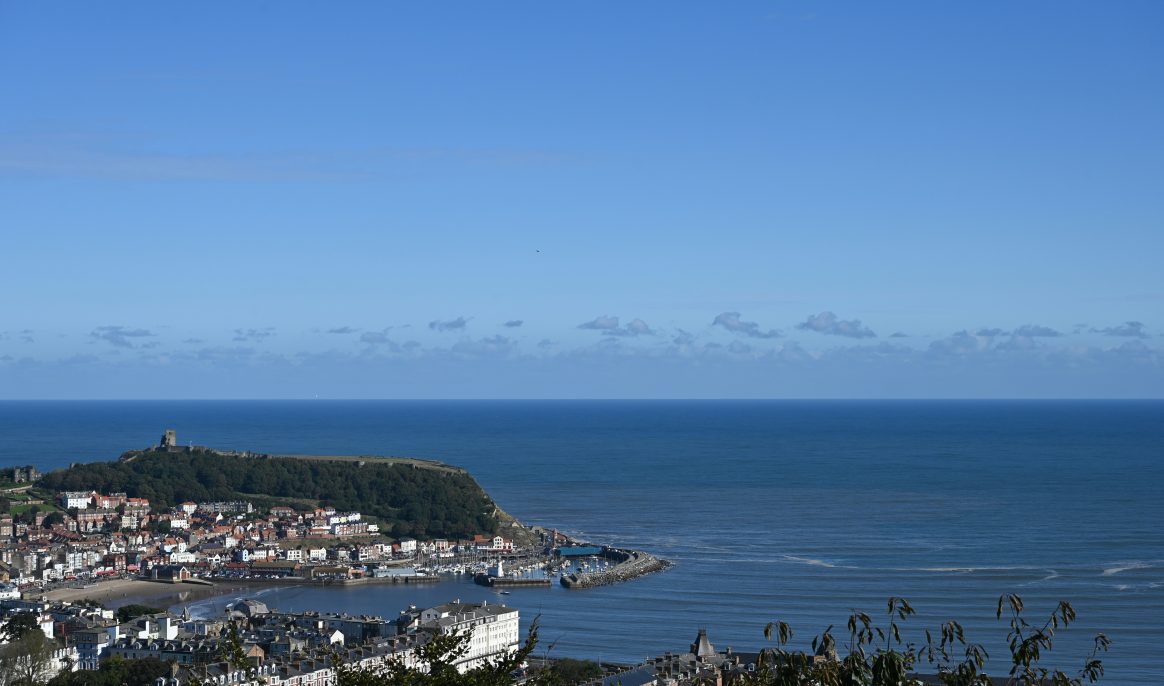
In Scarborough, a seaside resort in North Yorkshire overlooking the North Sea, archaeologists cut a hole in the lawn and found themselves face-to-face with a piece of the 20th century that had remained underground for nearly six decades. Beneath the ruins of a medieval royal fortress, a Cold War-era nuclear bunker has resurfaced. Built between 1963 and 1964, it had been sealed in 1968 before disappearing from view—until the excavations in March 2026.
That is the charm of Scarborough Castle: each layer of soil carries with it a different era, and none of them ever truly disappears. This promontory has been home to a succession of protohistoric settlements, a 4th-century Roman signal station, an early medieval chapel still visible through its archaeological remains, and finally the great fortress built in the 12th century. A Scandinavian influence also looms over the site, rooted in historical accounts and Icelandic literary tradition linked to Scarborough’s origins. The discovery of the bunker adds another layer of meaning to this already extremely dense stratification.
The organization that manages the castle knew that this Royal Observer Corps observation post was located somewhere in the park, but its exact location had been lost over time. To locate it, researchers had to rely on vintage photographs, local memory, analysis of existing data, and a new geophysical survey using ground-penetrating radar. Since the castle is a historic monument, excavations began on March 7, 2026, after receiving approval from the authorities. The entrance to the bunker became visible in just a few days.
A small, flooded bunker, with its wooden door and original paint
The shelter buried beneath the castle was not a massive underground citadel. It was one of those small observation posts built in large numbers across the United Kingdom to house three volunteers. These volunteers were tasked with recording nuclear explosions, shock waves, and radioactive fallout, then transmitting this data to the civil and military early-warning network. The choice of Scarborough, with its rocky headland overlooking the sea, followed an unyielding logic: from there, it was possible to observe potential detonations offshore, along a stretch of coastline considered sensitive during the most tense years of the Cold War.
When archaeologists removed the concrete slab covering the access shaft, they found water rising almost to the ceiling. The bunker was submerged, but this stagnant water, paradoxically, served as a guardian. The interior wooden door remained closed and still very sturdy, with a layer of paint that was surprisingly intact. To understand what had survived down there, the team completely cleared the broken ventilation shaft, removed the debris, and slid an endoscopic camera into the void of the underground chamber. The images revealed total flooding, structural elements that were still identifiable, and several clues to the presence of equipment and interior finishes. Among the materials uncovered were bricks stamped with the name “Scarborough,” produced at the nearby Seamer Road factory.
This type of station almost always followed the same construction guidelines. Work began by building the brick framework before pouring the concrete. Inside were communication equipment, a work table, rudimentary bunks, devices for measuring radiation levels and fallout, as well as a ventilation system—all under very spartan living conditions. One of the former volunteers recalled hours spent in the cold, inside “a concrete hut” with no heating, where his body would go numb after just a few hours. The ROC’s network of stations was extremely dense: more than 1,500 facilities across the United Kingdom, staffed over time by more than 20,000 volunteers from the British Civil Defense.
For now, a full reopening to the public remains a distant prospect. The water level, the condition of the room, and the complexity of the site make restoration difficult. Yet the value of this discovery is obvious: Scarborough Castle already embodies the Bronze and Iron Ages, ancient Rome, the early Middle Ages, the medieval monarchy, sieges, artillery, and the 20th century. Now, the Cold War, too, is clearly woven into this narrative, with its stark engineering, technical jargon, and vision of an apocalypse managed by uniformed volunteers. On this English headland, the wind continues to shift as it always has. Above, the walls still stand. Below, a structure designed for Armageddon still hovers.
Source: English Heritage
Share: