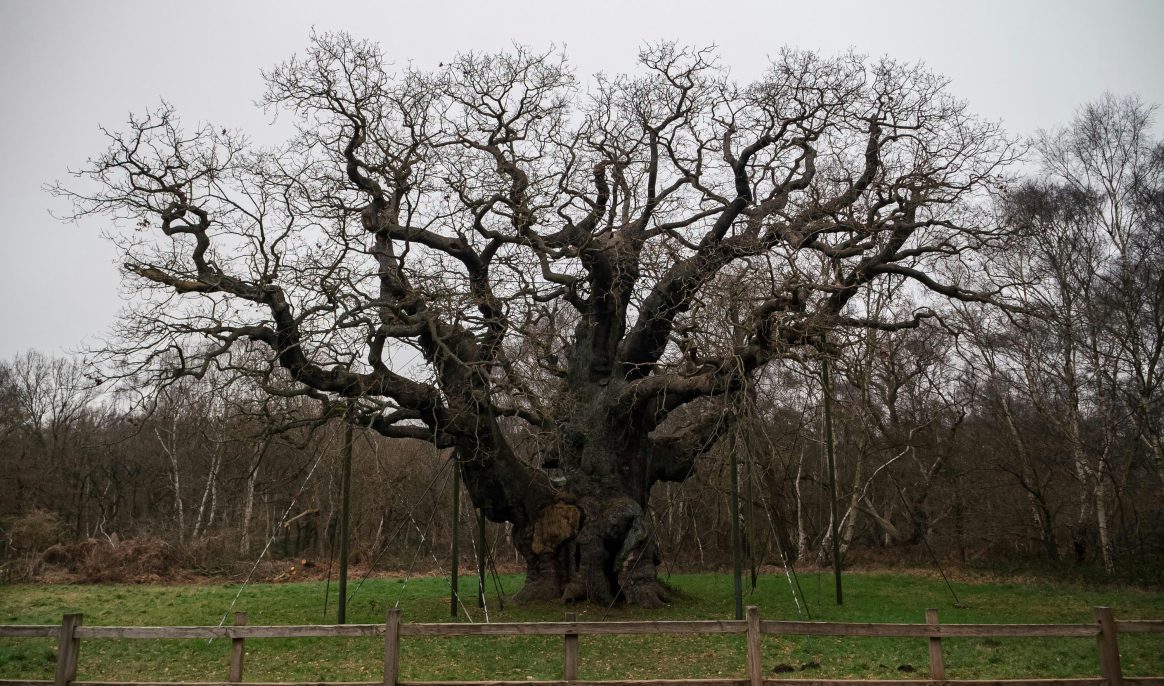
©Luke Galloway via Unsplash - photo d'illustration du Major Oak
-
Jun 26, 2026 14:05
For over a thousand years, it reigned at the heart of Sherwood Forest, becoming a symbol of legends, biodiversity, and collective memory. Today, the Major Oak—the famous oak inextricably linked to the legend of Robin Hood—is officially dead.
The announcement was made by experts who had been monitoring the condition of this monumental tree for years, after observing that, for the first time, it had failed to produce new leaves during the spring.
We are in Nottinghamshire, England, and this gigantic oak was considered one of the oldest in the United Kingdom. According to estimates, its age ranged from 800 to 1,200 years. A true natural monument that, over the centuries, withstood fires, storms, snowfall, and even the recent heat waves caused by the climate crisis.
The foretold death of a giant
Experts from the Royal Society for the Protection of Birds (RSPB), the organization that manages Sherwood Forest, explain that there's no single cause responsible for the tree’s demise. Rather, it's the result of a combination of factors that have accumulated over time.
Among these, the pressure and trampling caused by millions of visitors who came to admire the famous oak over the years are believed to have played a major role. This constant foot traffic gradually compacted the soil around the roots, making it harder for the tree to absorb water, oxygen, and essential nutrients.
To make matters worse, the increasingly devastating effects of the climate crisis have been added to the list. In recent years, the United Kingdom has experienced exceptionally hot and dry summers, with record-breaking temperatures that have put forest ecosystems to the test. According to experts monitoring the Major Oak, the tree’s decline coincided with at least five summers marked by extreme heat and prolonged drought.
Paradoxically, some of the measures taken to protect the oak may also have contributed to its fragility. Over the past hundred years, numerous supports have been installed to prop up the tree’s large branches and preserve its structure.
These measures, experts say, may have disrupted some of the plant’s natural adaptive processes. In recent years, conservationists had focused their efforts primarily on restoring soil quality, which has now been severely degraded by tourist pressure.
Despite its biological death, the Major Oak will not be cut down. Its gigantic structure will remain in Sherwood Forest, slowly transforming into a valuable habitat for insects, fungi, birds, and other forms of life.
Indeed, dead monumental trees play a fundamental role in forest ecosystems, becoming true refuges for biodiversity.
Furthermore, the Major Oak’s genetic legacy will live on through the many young oak trees grown from its acorns and planted in various parts of the world. Among those who own one of its descendants is British actress Judi Dench, who has long been committed to protecting ancient trees.
The loss of the Major Oak symbolizes the fragility of our natural heritage in the face of phenomena we often underestimate: unregulated tourism, soil degradation, and the increasingly severe effects of climate change. As experts point out, trees do not simply die of old age; had environmental conditions been suitable, an oak like the Major Oak could have continued to live for hundreds more years.
Its legacy now extends beyond the story of Robin Hood, serving as a valuable lesson for the conservation of monumental trees around the world.
Share: