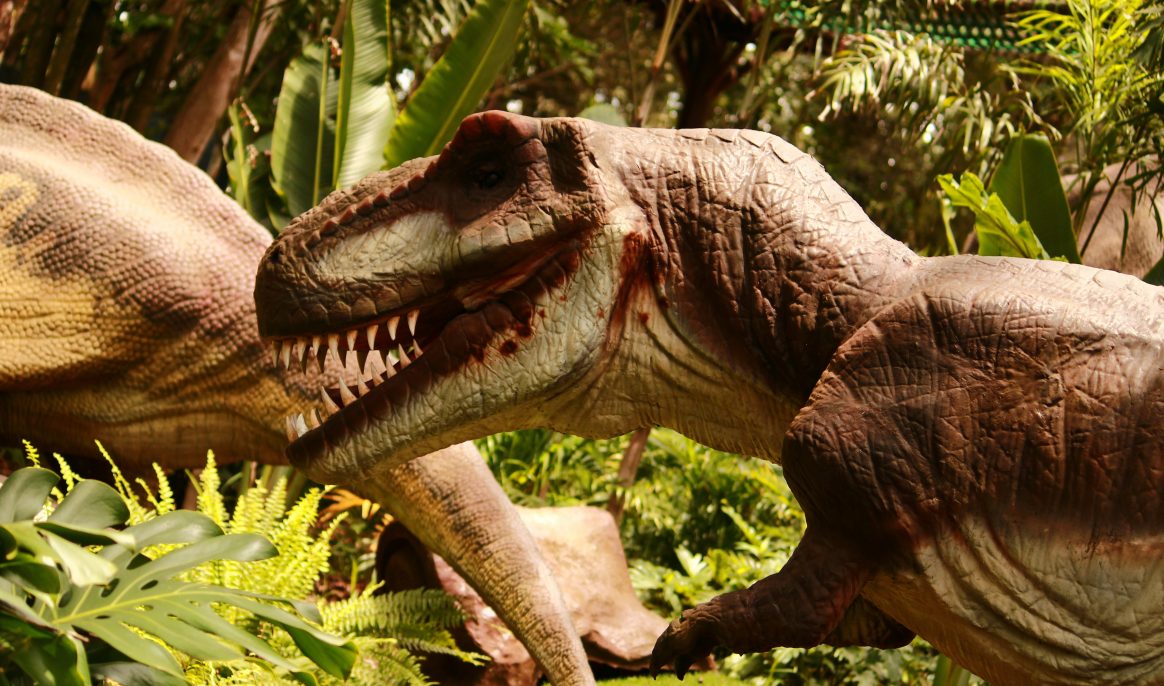
©Blond Fox via Unsplash - photo d'illustration
-
Jun 19, 2026 14:45
A research team led by the Carnegie Museum of Natural History (United States) has announced the discovery of a new species of dinosaur that lived 120 million years ago, named Jian changamaensis and related to the famous Velociraptor, described as a sort of “four-winged dragon.”
The name given to the species, Jian changamaensis, is no coincidence: first, Jiān was a bird from Chinese mythology with a single eye and a single wing. Changamaensis, meanwhile, pays homage to the area where it was discovered—the Changma Basin in northwestern China—which is one of the country’s richest fossil sites.
“For decades, the Changma site has been renowned among paleontologists for its extraordinary bird fossils,” explains Matt Lamanna, the study’s lead author. “Now, with the discovery of Jian, we finally know who was eating them.”
In recent years, hundreds of fossils belonging to avian dinosaurs—the ancestors of modern birds—have been unearthed at this site. Most of these remains consist of bone fragments that closely resemble regurgitation pellets—those compact clumps of undigested material that modern birds of prey, such as owls, regurgitate after their meals.
Jian may also have fed on Gansus yumenensis, one of the earliest birds of the dinosaur era ever discovered in China, which paleontologists unearthed in 1981 in the Changma Basin itself.
The species, a relative of Velociraptor, is a microraptor—a genus of small, four-winged dinosaurs belonging to the Dromaeosauridae family. The new study, conducted through the analysis of intact shoulder and forelimb bones, has however demonstrated that the fossil belonged to a previously unknown species of microraptor. The discovery thus extends the timeline of these feathered dinosaurs’ existence.
“[Jian] broadens the geographic range and helps highlight the anatomical diversity of this group,” comments Alexander Dececchi, an assistant professor at the College of Arts and Sciences at Dakota State University in Madison (United States), who did not participate in this study. “All these elements are important for determining where, when, and which of them were capable of flight.”
“But note that, although it had four wings, this dinosaur has been classified as a ‘non-avian’ species—in other words, it was not a bird as we imagine it. Microraptor actually lived on the ground, even though it may have learned to nest in trees and glide from branch to branch to stay out of reach of larger carnivorous dinosaurs.”
“These creatures may have started out living on the ground, then began climbing, and once in the trees, developed features that helped them stay there,” explains Matt Lamanna.
This fossil will allow scientists to study the evolution of wings and flight in Microraptors. In the meantime, the next step will be to scan the wing to see what it might reveal about the Microraptors’ ability to fly or glide.
The study was published in the journal Annals of the Carnegie Museum.
Sources: Carnegie Museum of Natural History/Facebook / Annals of Carnegie Museum / CNN
Share: