
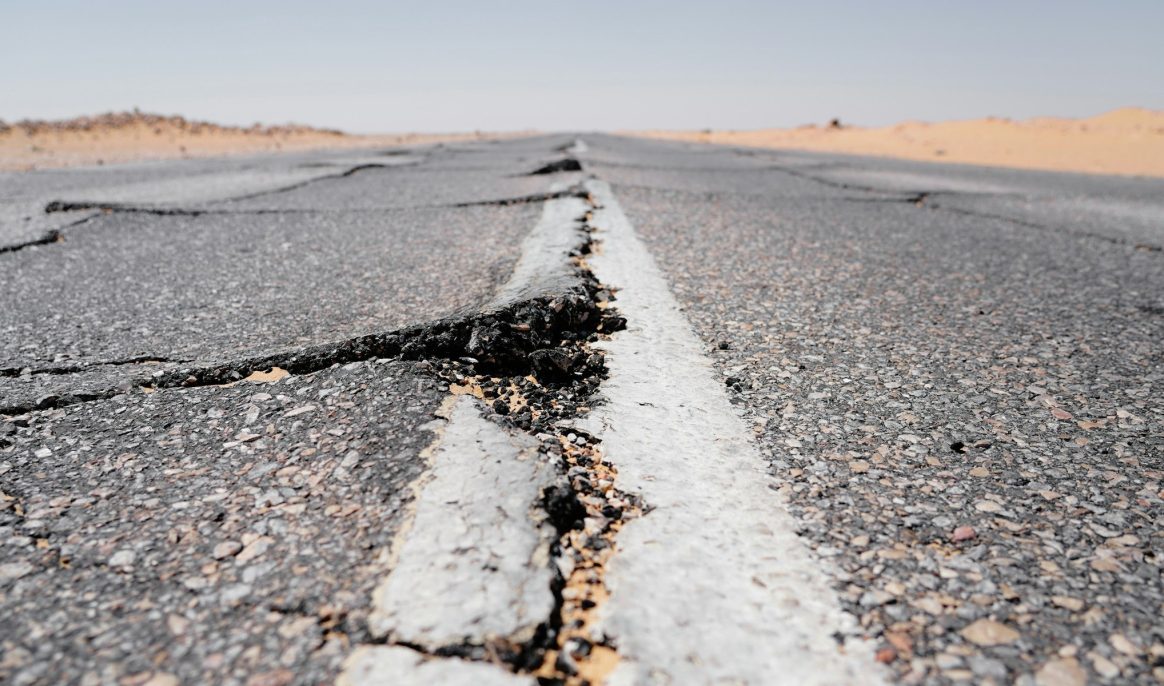
©Unsplash
-
Sep 18, 2026 10:30
Our planet vibrates, breathes, constantly readjusts itself beneath our feet. And if we're used to thinking of earthquakes as phenomena generated exclusively in the depths of the Earth's crust, a new scientific hypothesis invites us to look much higher up, towards the Sun.
A team of researchers from Kyoto University has proposed a theoretical model that explores a possible link between solar storms and earthquakes, suggesting that ionospheric disturbances could, under certain conditions, contribute to triggering seismic events already "in unstable equilibrium".
This is neither science fiction nor alarmism. It's a new perspective that interweaves geophysics, plasma physics and atmospheric science, and broadens the way we interpret the origins of earthquakes.
When the Sun emits intense flares, the increased solar activity modifies the ionosphere, the layer of the atmosphere rich in electrically charged particles. In these phases, electron density can increase significantly, creating a negatively charged layer in the lower part of the ionosphere.
According to the model developed by the Japanese researchers, this variation could generate electric fields capable of penetrating fracture zones in the Earth's crust.
Seismically active regions are not in fact compact blocks of rock: within them exist microfractures filled with water at extremely high temperatures and pressures, sometimes in a supercritical state. From an electrical point of view, these regions could behave like immense natural condensers, connected to both the earth's surface and the ionosphere, forming an electrostatic system on a planetary scale.
When solar activity increases and the total electronic content - measured in TEC units - rises by several tens ofunits, the electrostatic pressure inside these rock cavities could reach several megapascals. We're talking here about values comparable to tidal stresses or gravitational forces already recognized as factors likely to influence fault stability.
The key point remains: this mechanism could only act on faults that are already critically stressed, i.e. close to rupture. In a system already on the verge of collapse, even additional stress can be decisive.
For years, scientists have been observing unusual phenomena in the ionosphere prior to certain high-magnitude earthquakes. These include electron density peaks, variations in ionospheric altitude and changes in medium-scale ionospheric wave propagation.
Traditionally, these anomalies were interpreted as effects caused by accumulated stress in the Earth's crust. The new model proposes a more complex, bidirectional view: the Earth's internal processes can influence the ionosphere and, under certain conditions, the ionosphere can exert back pressure on the crust.
Recent examples include the Noto Peninsula earthquake in 2024, which occurred shortly after a period of intense solar activity. This temporal coincidence does not demonstrate a direct causal link, but it is part of a dynamic that merits systematic investigation.
The aim of this hypothesis is not to predict earthquakes. The challenge is different: to better understand the triggering mechanisms. Simultaneously monitoring ionospheric conditions and underground parameters could provide new tools for refining seismic risk assessment.
For decades, we have regarded earthquakes as phenomena governed exclusively by forces internal to the planet. This new approach broadens the framework and introduces the idea that space weather could interact with already weakened terrestrial systems.
Share: