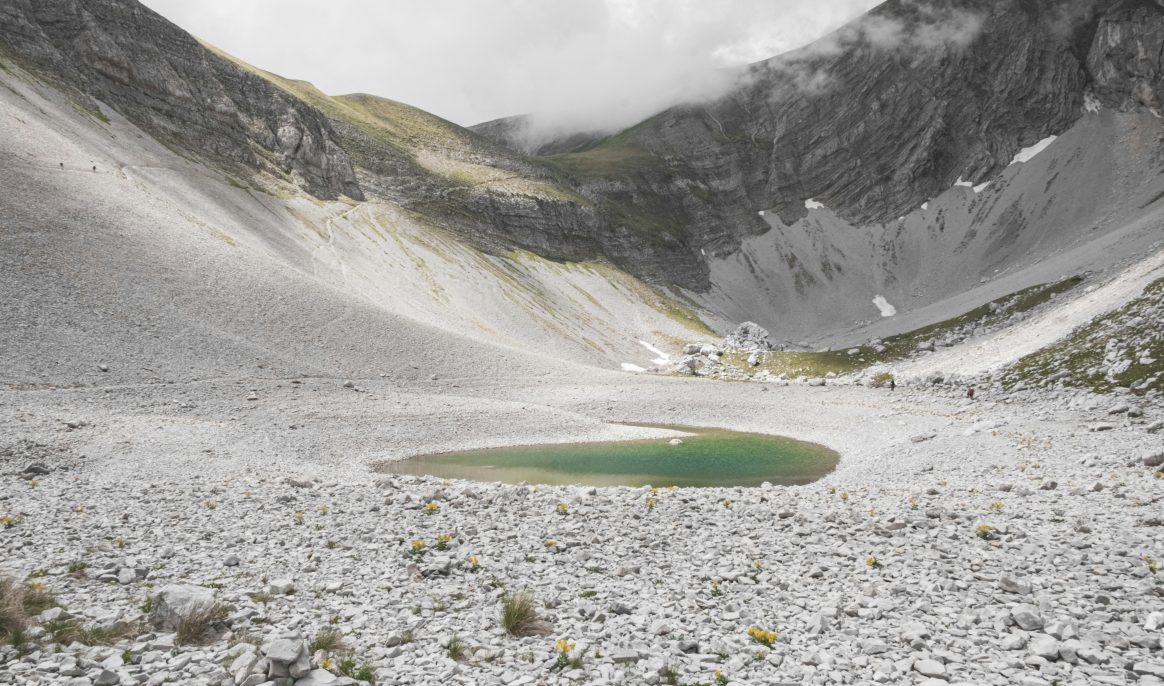
©Daniele Franchi via Unsplash - photo d'illustration du lac de Pilate
-
Jun 21, 2026 14:11
In the Marche region, Lake Pilate (Sibillini Mountains) has regained its famous “spectacles” shape after 10 years, thanks to the melting snow on Mount Vettore. This is the habitat of Marchesoni’s chirocephalus, an extremely rare crustacean endemic to this area and found nowhere else in the world.
For those who associate the summer months with wilderness and the cool temperatures of the Apennine peaks, a natural event of exceptional significance is reshaping the high-altitude geography of central Italy. In the heart of the Sibillini Mountains National Park, the only glacial basin in the Marche region has regained its most spectacular appearance. Lake Pilate has, in fact, regained its famous “spectacles” shape. This hydrological phenomenon, which had not been observed for nearly a decade, immediately caught the attention of scientists, hikers, and mountaineers.
The rebirth of the double basin at an altitude of 2,000 meters
Nestled at an altitude of 1,941 meters on the steep slopes of Mount Vettore, the site had recently been severely compromised by a prolonged drought and a sharp decline in winter snowfall. These adverse climatic conditions had gradually depleted the basin, leaving the two glacial basins separated and isolated from one another, like two distinct ponds.
However, the abundant snowfall accumulated during the last cold season reversed the trend: the gradual melting of residual snow at higher elevations has released enough water to bridge the elevation difference, reuniting the two bodies of water into a single, striking geometric shape.
Expert monitoring and protection of the Marchesoni Chiropetal
Mountaineer Sara Marcelli documented the merging of the bodies of water: during a hike along the massif’s trails, she observed that water levels continued to rise due to the snow accumulations still covering the rocky slopes. The return to the original water level is not only a landscape achievement of rare beauty but also a vital element for the local ecosystem.
These crystal-clear waters are, in fact, the only terrestrial habitat in which Marchesoni’s chirocephalus survives—a rare endemic crustacean (unique in the world) that is closely dependent on the biological and thermal stability of this Apennine basin. For lovers of leisurely hikes, the mountain has restored its most precious symbol.
Share: