
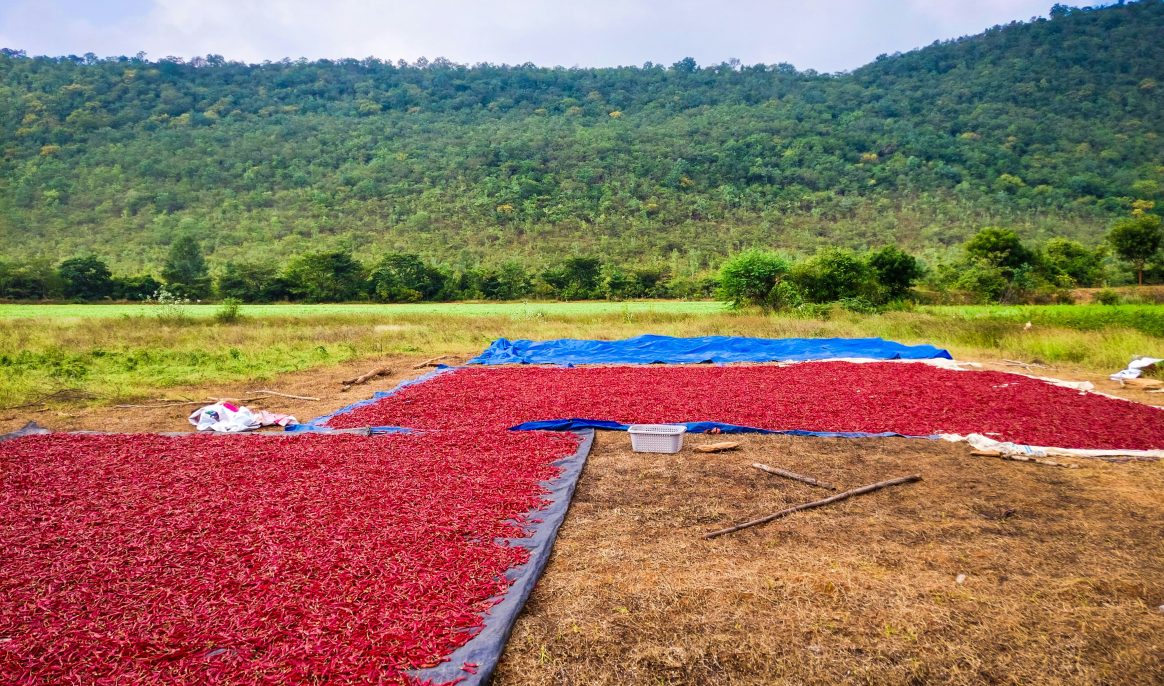
©Anudeep via Unsplash - photo d'illustration d'un champ dans l'Andhra Pradesh
-
Jun 20, 2026 15:21
Over the past ten years, 1.8 million farmers in southern India have joined what is now one of the world’s largest transitions to natural agriculture.
While much of the world’s agriculture continues to grapple with the effects of the climate crisis, biodiversity loss, and dependence on chemical fertilizers and pesticides, a story from India could well change our vision of the future of food.
The Andhra Pradesh Community Managed Natural Farming (APCNF) program, one of the world’s largest farmer-led agroecological initiatives, has won the 2026 Food Planet Prize, considered the most prestigious international award dedicated to the sustainability of food systems.
This award, presented in Sweden and accompanied by a prize of $1.5 million, recognizes an initiative that, over the past ten years, has mobilized nearly 1.8 million farmers in the Indian state of Andhra Pradesh, guiding them toward natural farming practices with low environmental impact.
The project is based on a simple yet revolutionary idea: gradually reducing dependence on chemical inputs and reviving agricultural practices that respect the natural balance of ecosystems.
In practice, farmers adopt techniques such as permanent soil cover, promoting biodiversity, reducing the use of synthetic fertilizers and pesticides, and using planting systems that better conserve water and improve soil fertility.
One of the most interesting aspects of this project lies precisely in the convergence of traditional knowledge and modern scientific research. These practices are monitored, studied, and constantly improved through a network of agricultural facilitators and local communities. To date, this model has been implemented in more than 8,000 villages.
The role of women
This project is all the more compelling because women play a central role in it. The entire initiative relies on a vast network of women’s self-help groups that contribute to training, knowledge sharing, and the organization of rural communities.
According to program officials, more than 340,000 women’s groups are involved in this agricultural transition process. It is a concrete example of how environmental sustainability, social inclusion, and women’s empowerment can advance hand in hand.
“Farmer scientists”
One of the most innovative features of the Indian model is the concept of “farmer scientists.” The farmers themselves participate in field experiments, collect data, document the results, and contribute to the generation of new agricultural knowledge.
Part of the grant will be used specifically to strengthen this citizen-led innovation network, as well as to fund pilot farms, international training programs, and new scientific studies on the effects of natural farming on biodiversity, soil fertility, and climate resilience.
At a time when global food security is threatened by extreme weather events, water scarcity, and land degradation, the experience in Andhra Pradesh demonstrates that large-scale transformation is possible.
Source: Food Planet Prize 2026
Share: