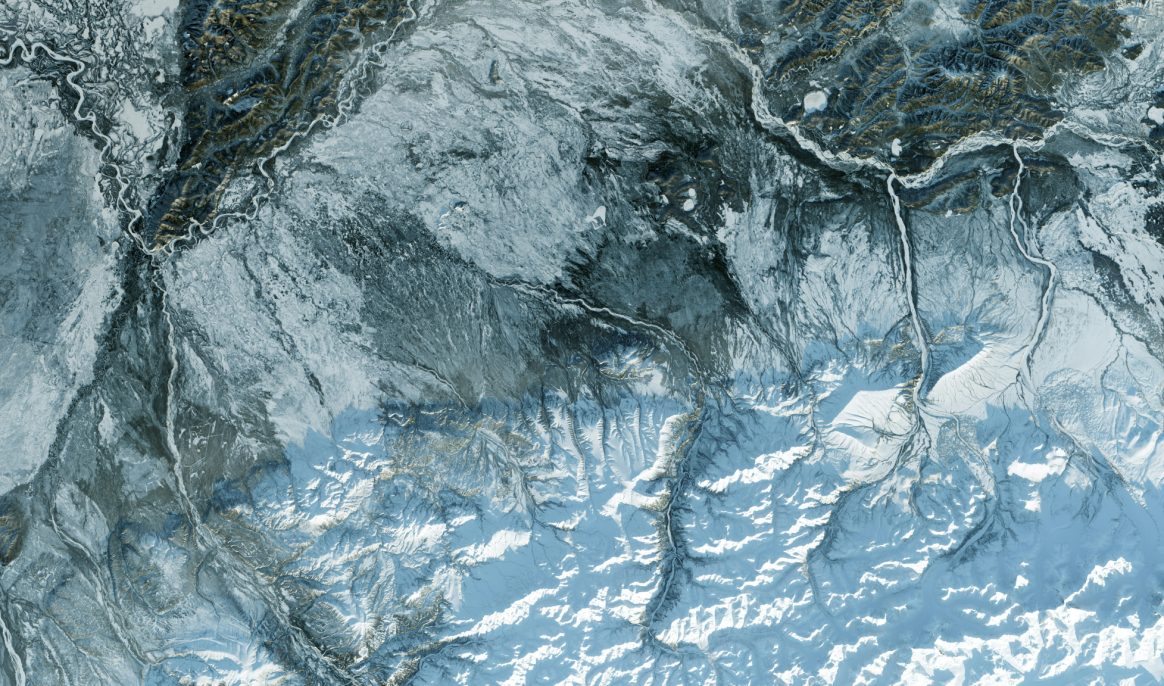
©USGS via Unsplash
-
Jan 27, 2026 05:30
Amid this global climate crisis, while we see images of crumbling glaciers on a daily basis, there exists a place that defies all expectations. Indeed, in the heart of Central Asia, among the towering peaks of the Pamir Mountains, there's a huge glacier that not only lives on, but continues to grow.
Called the Vanch-Yakh Glacier, it's among the longest glaciers outside polar regions. For decades, it has shown remarkable stability, entirely against trends of the bulk of the Earth's glacier masses, which are currently shrinking at a rapid pace.
Why can growing glacier tell us something new
The region in which it lies, in Tajikistan, harbors another climate conundrum: the Kon-Chukurbashi ice sheet. Indeed, here, at extreme altitudes, the ice seems to follow its own rules. To understand exactly what is happening, an international scientific expedition decided to pierce the ice sheet and extract ice cores up to a hundred meters deep.
These ice cylinders, about the size of a tin can, contain a natural chronicle covering some 30,000 years of climate history. Each layer preserves tiny chemical traces, dust and sediments that tell us what the earth looked like when that water turned into ice.
According to Yoshinori Iizuka, professor at the Institute of Low Temperature Science at the University of Hokkaido, understanding the cause of this growth could prove very valuable. The ambitious idea is that the mechanism protecting these glaciers may also provide useful clues for other glaciers, which are becoming increasingly vulnerable today.
Ancient ice cores, unexpected dust particles and an unsolved mystery
While analyzing the samples, scientists stumbled upon something unexpected. Deeper than seventy meters, the ice turns out to be unusually rich in dust and in amounts that had not yet been observed on similar expeditions. In the last meters, the ice even takes on a yellowish color, a detail that raises new questions and will be investigated further in Japanese laboratories.
The analyses are still in progress, but it's clear that glaciers in the Pamir behave differently from those in many other mountain ranges. This resilience could be related to local climatic factors, atmospheric circulation or processes that we still have a poor understanding of.
Behind this research is not only scientific curiosity, but a race against time as well. In late September 2025, the Ice Memory Foundation led an international expedition to the Pamir Glaciers, with 13 scientists working at an altitude of 5,800 meters, on the Kon-Chukurbashi ice sheet.
There, deep ice cores, more than 100 meters in length, were drilled for the first time: a true natural archive preserving centuries, perhaps millennia, of climate, dust and atmosphere of one of the world's most vulnerable and least studied regions. One of these samples will be examined directly; the other will be stored in Antarctica, in the foundation's 'ice sanctuary', as a memory to be safeguarded before global warming makes it impossible to recover. Because even where the ice seems to hold today, the signs of change can already be seen in every layer.
An extreme expedition between ice, helicopters and global science
The mission, followed on site by AFP, brought together researchers from Switzerland, Russia, Japan and Tajikistan. The ice cores were transported on the shoulder, in refrigerated segments, over particularly difficult terrain to all-terrain vehicles and refrigerated trucks. The project was supported by a Swiss climate institute and the Ice Memory Foundation, which is dedicated to preserving ice cores in Antarctica to save them from irreversible thaw. The undertaking, which was characterized as a race against time, aims to secure natural archives that would otherwise disappear irrevocably.
A simple or immediate solution may not exist. But if, among those ancient air bubbles and mysterious dust particles, there's a clue that could explain why this glacier is growing, the Vanch-Yakh could help us understand how to better protect the planet's glaciers. In an era of negative environmental news, this story is not a fairy tale with a happy ending, but it's a rare sign of complexity. And it reminds us that, even under pressure, nature can still surprise.
Share: