
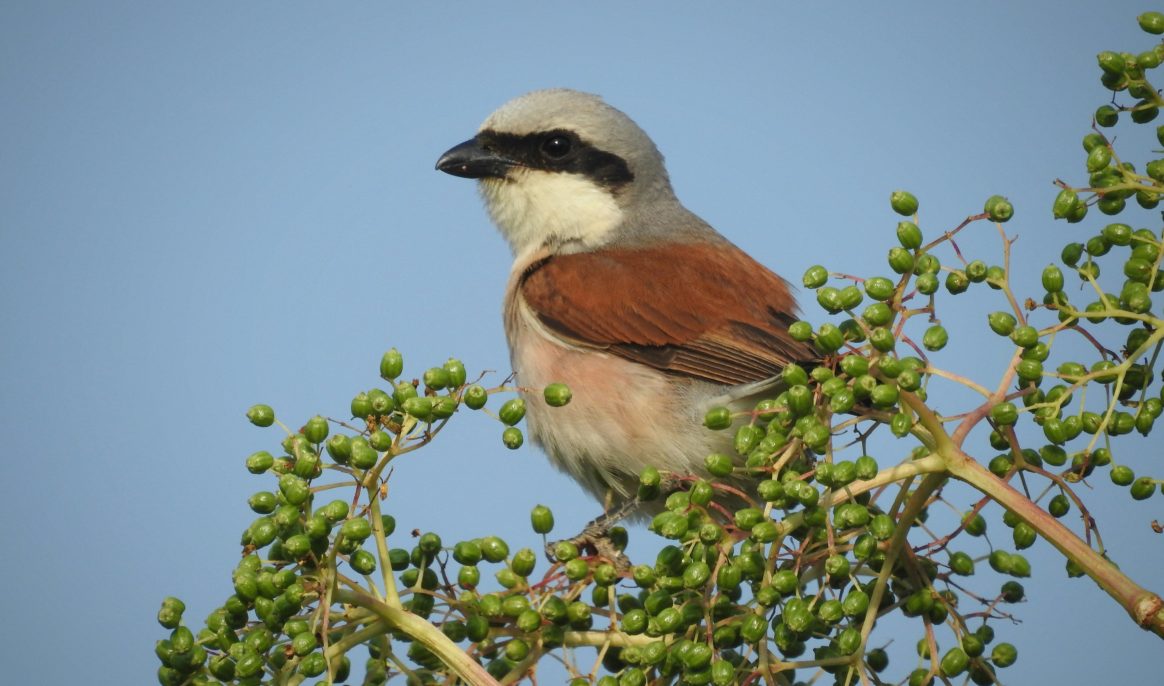
©Lukáš Kadava via Unsplash - photo d'illustration de Pie-grièche écorcheur
-
May 30, 2026 14:17
A pair of Red-backed Shrikes traveled the distance between South Africa and the Apennines of Pistoia to find the same roost after a journey of 12,000km, demonstrating an extraordinary memory while surprising experts.
In the heart of the Pistoia Apennines, within the Oasi Dynamo protected area, two small birds have accomplished a feat that goes beyond simple seasonal migration. They are the Red-backed Shrike (Lanius collurio), a species capable of crossing entire continents and finding its point of departure with astonishing precision.
The reserve's photographic traps documented the return of the same pair after a journey of some 12,000 kilometers, between southern Africa, the Sahara desert and the Mediterranean. Not only have the pair returned to the same area, but they have also taken up residence on the artificial perch used in previous years.
CA and AC: two lives intertwined in the migratory sky
The protagonists are two individuals identified through scientific ringing: the female "CA", tracked since 2024, and the male "AC", registered since 2022 and considered one of the oldest observed on the site. Both were photographed on "perch 5", a structure designed for behavioral studies.
The tracking system, based on photographic traps and the reading of colored rings, enables individuals to be followed without any direct interference. The project is coordinated by Oasi Dynamo with the support of wildlife researchers and technicians, in collaboration with the CNR in Florence and the Progetto Migratoria association.
A sentinel species for agricultural ecosystems
The Red-backed Shrike is considered an indicator species for the health of European rural environments. A predator of insects and small vertebrates, it depends on traditional agricultural landscapes rich in hedges and bushes. In recent decades, it has suffered a sharp decline as a result of intensive farming, habitat loss and the use of plant protection products. Its regular return to the Pistoia Apennines is therefore a positive sign for the ecological quality of the reserve.
The data collected had already highlighted cases of fidelity to breeding sites, but rarely with such extreme precision. The return of the same pair to the same roost reinforces the hypothesis of exceptional spatial memory in small trans-Saharan migrants. A result that enriches our knowledge of migratory routes and contributes to the protection of an increasingly vulnerable species.
Source : Oasi Dynamo
Share: