© Champers Fu via Unsplash
-
May 28, 2026 11:20
When we think of climate change, we immediately think of heatwaves, drought or rising sea levels. Yet global warming is also influencing other weather phenomena, such as hail. One study reveals that hailstones are getting bigger and more destructive, even though hail storms aren't necessarily more frequent.
The warning has been confirmed in a study published by the journal Nature on May 27, 2026, reports Le Monde and Le Figaro. According to the researchers, two main physical mechanisms explain the swelling of hail. On the one hand, a warmer atmosphere contains more water vapor, which increases the likelihood of larger hailstone formation. Secondly, higher temperatures raise the altitude at which ice melts. As a result, smaller hailstones melt more easily before reaching the ground and turn into rain, while larger hailstones survive until impact.
As reported by Le Monde, "climate change is not leading to more frequent hailstorms, but rather more intense ones, with larger hailstones", summarizes Davide Faranda, research director at the Laboratoire des sciences du climat et de l'environnement.
The figures confirm this trend. According to projections for the period 2020-2100, the frequency of large hailstones over 3cm is set to increase by 38% to 52%, depending on the global warming scenario (+2.7°C to +4.5°C). Conversely, small hailstones smaller than 3cm will decrease by 4% to 12%. This doesn't mean that there will be more hail storms, but that the most violent storms will produce far more larger, destructive hailstones.
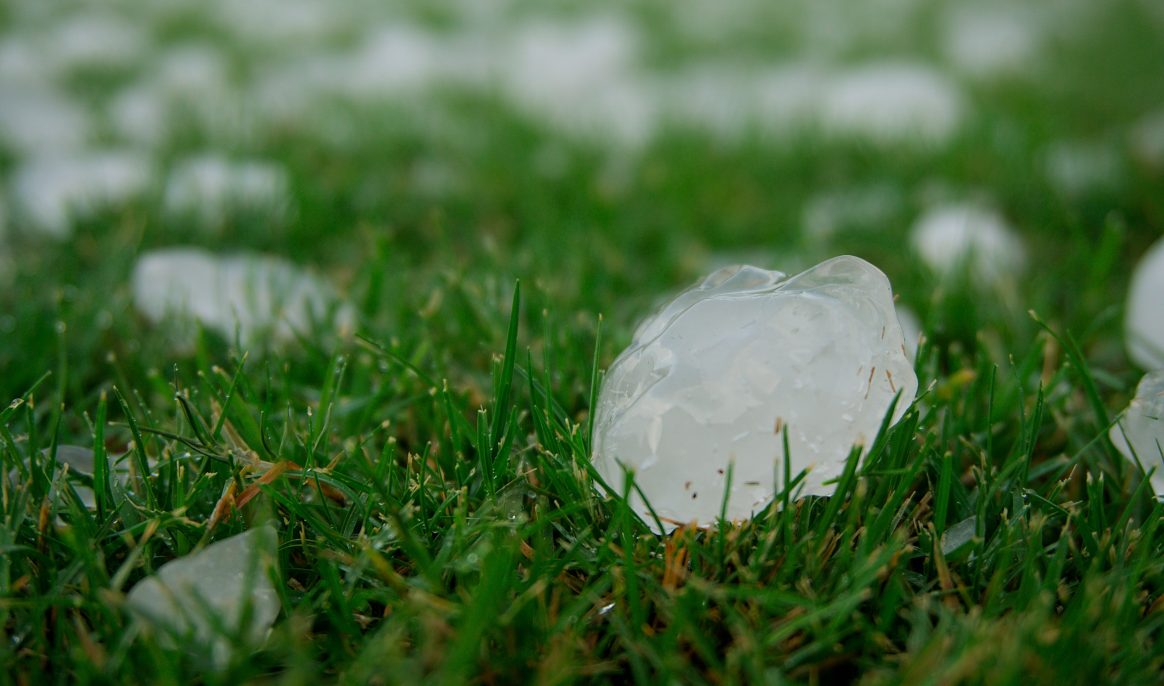
And this scenario is no longer fiction. Records have already been set in recent years. In June 2022, a 13cm hailstone fell at Vic-en-Bigorre in the Hautes-Pyrénées region, setting the French record. In June 2025, a 10cm hailstone hit Aquitaine. Paris had already seen an 8cm hailstone in June 2014. In the USA, a 20cm hailstone, equivalent to a bullet, was measured in South Dakota in 2010. These sizes far exceed those of a single pea or marble: a 10cm hailstone is equivalent to a small apple, and a 20 cmone to a grapefruit.
For the first time in Europe, an attribution study published in March 2026 has established the direct impact of climate change on a specific hail event: that of May 3, 2025, which affected Paris and several regions of France and Germany. The researchers showed that the probability of larger hail stones increased by up to 30% in Paris and the surrounding area, and that the size of hailstones increased by up to 2cm as a result of warming. Simulated sizes go from a weakly damaging regime of 3 to 4cm to clearly destructive values.
"Hail can no longer be considered a marginal or localized hazard. In a warmer climate, these events become more intense and affect larger areas, including large conurbations," warns Davide Faranda.
The consequences are direct. Bigger hailstones fall faster, increasing impact energy and damage to crops, roofs, vehicles and infrastructure. Economic losses are on the rise, as are insurance claims.
Share: